Model 19 · Bitcoin Fundamentals
The SHA-256 Hashing Machine
A fingerprint for any data, computed step by step.
Explanation level
How to use this model
How to use this modelWhat you see, what you can touch, what changes, what to take away
What am I looking at?
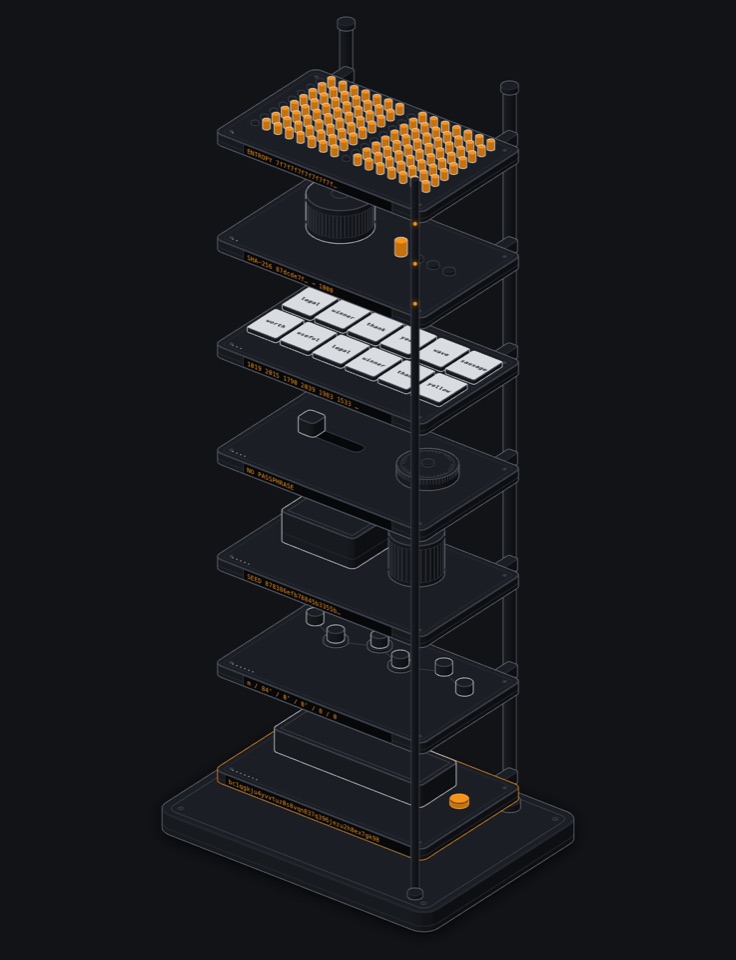
A processing line: an input tape, a padding press showing one 512-bit block, eight register wheels turning through 64 rounds on a round counter, a message-schedule rack and a 16 × 16 digest grid.
What can I touch?
- Enter harmless demonstration text
- Change one character
- Observe the resulting hash change
- Compare two hashes
What happens when I change something?
Change a single character and the 256-bit grid changes almost completely, about half its bits flip; type the same text again and you get exactly the same hash.
What should I understand afterwards?
Explain why the same input always gives the same hash and a tiny change gives a very different one.
Understand hashing as a deterministic fingerprint of data.
Same input, same fingerprint; tiny change, new fingerprint.
After this you can
- Explain why the same input always gives the same hash and a tiny change gives a very different one.
Experiment with different inputs.
Change one character, compare, play the rounds.
After this you can
- Observe that changing one character flips about half of the 256 bits.
Explore padding, compression rounds, bitwise operations and Bitcoin's uses of hashing.
FIPS 180-4 step by step, SHA-256d.
After this you can
- Describe SHA-256 padding, the message schedule and the compression rounds.
Open the model in its own window · works offline once loaded
Missions operate the model to complete them
-
One character, half the bits
BeginnerCompletedSee the avalanche effect with your own inputs.
Your task: Make the two inputs differ in exactly one character, and find a pair where more than 135 of the 256 bits change.
Use: Enter harmless demonstration text · Change one character · Compare two hashes · Explore the avalanche effect
Any change spreads through all 64 rounds, so the output looks unrelated: on average half the bits flip, and how many exactly varies from pair to pair.
Missions are checked from the model's own simulation state, not from clicks. No time limit. Completion is stored only in this browser. The quiz questions in the learning paths remain available.
Tutor Ask a question, or let the tutor show you around
The tutor answers by explaining and, within the permissions below, by operating this model. Every change it makes is shown and listed, and you can undo it. It cannot run code, read your browser data or see anything secret. The page works the same without it.
What the tutor did
Common mix-ups
- Myth: Hashing is a kind of encryption.
- In fact: There is no key and nothing to decrypt; a hash only fingerprints data.
- Myth: Similar inputs give similar hashes.
- In fact: The avalanche effect makes one changed character flip about half the output bits.
Concepts in this model
Next recommended
Part of these learning paths