Model 01 · Bitcoin Fundamentals
The Life of a Transaction
Follow one payment from your wallet to the blockchain.
Explanation level
How to use this model
How to use this modelWhat you see, what you can touch, what changes, what to take away
What am I looking at?
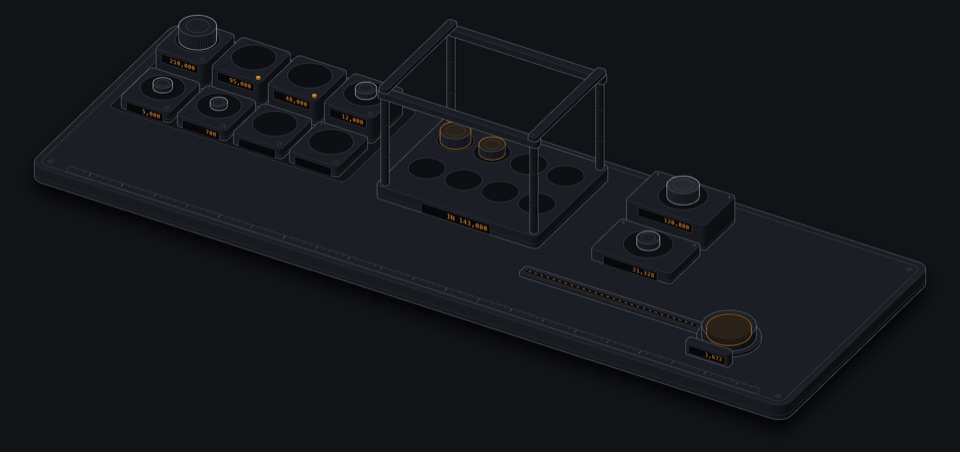
A horizontal precision workbench with six stations a transaction travels through: build, sign, broadcast, mempool, mining, confirmation.
What can I touch?
- Hover to inspect components
- Click to select mechanisms
- Scrub through the transaction timeline
- Arrow keys move between stages
What happens when I change something?
Raise the fee rate and the fee grows with the transaction's size in virtual bytes, while the change coming back to you shrinks by exactly the same number of satoshis.
What should I understand afterwards?
Describe the six stages a payment passes through.
Watch a payment travel through the machine.
A parcel being packed, sealed, posted, sorted, loaded and delivered.
After this you can
- Describe the six stages a payment passes through.
Change the amount and fee rate and see the change output and wait respond.
Cause and effect at each station.
After this you can
- Predict how a higher fee rate changes the fee and the change output.
Inspect UTXOs, scripts, signatures, vsize and fee arithmetic.
Byte-level structures and rule domains per station.
After this you can
- Calculate fee = inputs − outputs and fee rate = fee / vsize for a given transaction.
Open the model in its own window · works offline once loaded
Missions operate the model to complete them
-
Send a payment at a set fee rate
BeginnerCompletedBuild a valid payment and see it all the way to confirmation.
Your task: Pay exactly 250,000 sat at a fee rate of 20 sat/vB, then let the transaction travel until it is confirmed.
Use: Change the payment amount · Change the fee rate · Play and pause · Scrub through the transaction timeline
The fee is the fee rate times the transaction's virtual size, rounded up; a bigger payment can need more inputs, which makes the transaction larger and the fee higher at the same rate.
Missions are checked from the model's own simulation state, not from clicks. No time limit. Completion is stored only in this browser. The quiz questions in the learning paths remain available.
Audio guide Listen while you watch (optional)
Nothing plays until you press Play. The narration below is the same text, to read at your own pace. Each step brings its mechanism into focus in the model; the voice is not timed to the animations.
-
This guide follows one payment from the wallet to the blockchain. The figure moves to each station as I describe it. You can pause at any time and try the controls yourself.
-
First the wallet builds the transaction. It picks coins it already owns as inputs, adds an output for the person being paid, and sends any remainder back to itself as change. Whatever the inputs hold beyond the outputs is the fee.
-
Next the wallet signs. A signature proves that the owner of the coins agrees to exactly this transaction. Change a single detail afterwards and the signature no longer fits.
-
Now the signed transaction is sent to the network. Nodes pass it on to their neighbours, and each one checks the rules for itself before relaying it.
-
Valid transactions wait in each node's mempool, a waiting room for payments that are not yet in a block. Transactions that pay a higher fee per unit of size are usually picked first.
-
A miner gathers waiting transactions into a block and searches for a valid proof of work. When it finds one, the new block is shared with the network.
-
Once the block is accepted, the payment has its first confirmation. Every later block built on top adds one more, and with each one, undoing the payment becomes much harder.
Tutor Ask a question, or let the tutor show you around
The tutor answers by explaining and, within the permissions below, by operating this model. Every change it makes is shown and listed, and you can undo it. It cannot run code, read your browser data or see anything secret. The page works the same without it.
What the tutor did
Common mix-ups
- Myth: Bitcoin is sent from account to account.
- In fact: A transaction consumes whole outputs and creates new ones.
- Myth: A broadcast transaction is final.
- In fact: It is unconfirmed until included in a block, and gains safety with depth.
- Myth: There is one global mempool.
- In fact: Every node keeps its own mempool under its own policy.
Concepts in this model
Helpful to know first
Next recommended
Part of these learning paths