Model 15 · Security
The Bitcoin Security Arena
Why rewriting history gets harder with every block.
Explanation level
How to use this model
How to use this modelWhat you see, what you can touch, what changes, what to take away
What am I looking at?
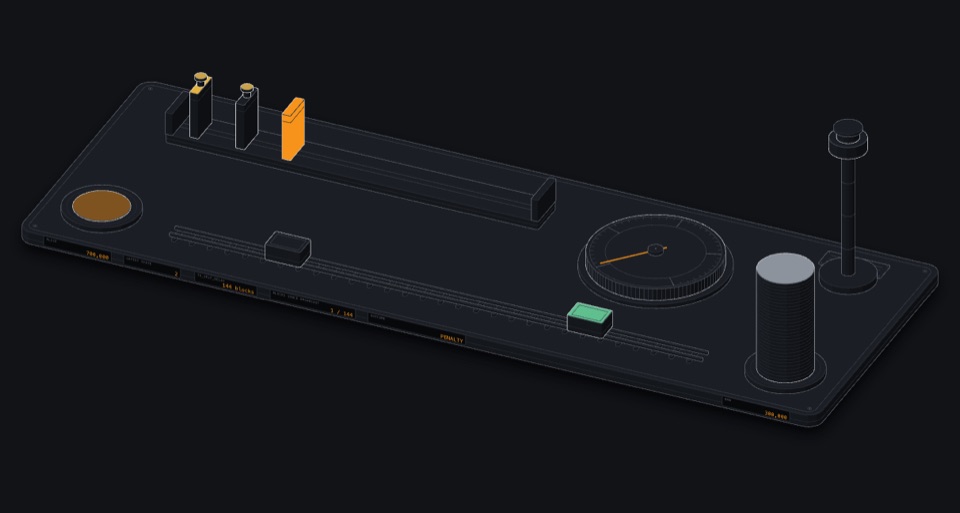
Two competing mechanical chain tracks, the honest network above and an attacker below, each with a cumulative-work gauge.
What can I touch?
- Adjust attacker hash share
- Start and pause mining
- Observe competing discoveries
- Change confirmation depth
What happens when I change something?
Give the attacker more hash rate or let the shop wait for fewer confirmations, and reorganisations that reverse the payment become more likely; more confirmations make them rarer but never impossible.
What should I understand afterwards?
Explain why more confirmations make a payment safer.
Understand why rewriting Bitcoin history is difficult.
A race the attacker must win from behind.
After this you can
- Explain why more confirmations make a payment safer.
Experiment with attacker mining power.
Hash share, confirmations, repeated races.
Explore probabilistic reorganizations, chainwork and assumptions.
Whitepaper §11 catch-up probability, simulation vs formula.
After this you can
- Compare simulated success rates with the whitepaper's catch-up probability.
Open the model in its own window · works offline once loaded
Missions operate the model to complete them
-
Watch a reorganisation happen
IntermediateCompletedSee an attacker's branch overtake the honest chain after the shop accepted the payment.
Your task: With the shop waiting for at least 2 confirmations, run races until one ends in a reorganisation.
Use: Adjust attacker hash share · Change confirmation depth · Start and pause mining · Run repeated simulations
Confirmations make reversal less likely, never impossible: with any hash rate the attacker can get lucky. The attacker only reversed its own payment; it could not touch anyone else's coins.
-
Find the 10 % threshold
AdvancedCompletedUse the exact race odds to find how much hash rate a 6-confirmation attack needs.
Your task: With 6 confirmations, set the smallest attacker share (in whole percent) at which the attack succeeds more than 10 % of the time.
Use: Adjust attacker hash share · Change confirmation depth · Compare probabilistic outcomes
The chance falls steeply with confirmations but rises quickly as the attacker approaches half the hash rate. These are the exact odds of this simplified race, including the attacker giving up 30 blocks behind. The whitepaper's figure differs for two reasons that pull in opposite directions: it counts drawing level as success, which raises it, and it approximates the attacker's progress with a Poisson distribution, which can lower it.
Missions are checked from the model's own simulation state, not from clicks. No time limit. Completion is stored only in this browser. The quiz questions in the learning paths remain available.
Tutor Ask a question, or let the tutor show you around
The tutor answers by explaining and, within the permissions below, by operating this model. Every change it makes is shown and listed, and you can undo it. It cannot run code, read your browser data or see anything secret. The page works the same without it.
What the tutor did
Common mix-ups
- Myth: A majority miner can create bitcoin or steal any coins.
- In fact: Nodes still reject invalid blocks; an attacker can only reorder or censor and double-spend their own coins.
- Myth: Six confirmations are an absolute guarantee.
- In fact: Confirmations make reversal less likely, never impossible.
Concepts in this model
Helpful to know first
Next recommended
Part of these learning paths