Model 12 · Economics
The Bitcoin Halving Clock
Why new bitcoin arrives ever more slowly.
Explanation level
How to use this model
How to use this modelWhat you see, what you can touch, what changes, what to take away
What am I looking at?
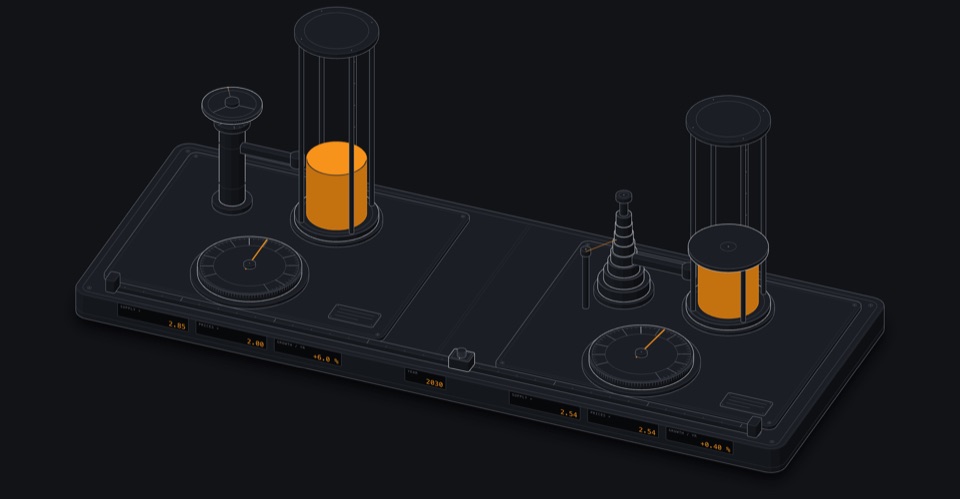
A precision circular clock: block-height counter, halving epoch indicator, subsidy display, cumulative and remaining issuance, epoch timeline.
What can I touch?
- Rotate the clock through history
- Advance block height
- Jump between epochs
- Observe subsidy reductions
What happens when I change something?
Turn the clock past a halving and the reward per block drops by half, so the issued total climbs ever more slowly towards its fixed limit.
What should I understand afterwards?
Explain why issuance decreases every 210,000 blocks.
Understand why new issuance decreases over time.
A tap that halves its flow on schedule.
After this you can
- Explain why issuance decreases every 210,000 blocks.
Travel through the issuance schedule.
Height → subsidy → supply.
Examine integer satoshi calculations and subsidy rules.
Right-shifts, rounding, the final supply.
After this you can
- Compute total issuance as Σ 210,000 × (5,000,000,000 >> n).
Open the model in its own window · works offline once loaded
Missions operate the model to complete them
-
Find the first sub-1-BTC era
BeginnerCompletedUse the halving schedule to find when the block reward drops below one bitcoin.
Your task: Turn the clock to a block whose reward is below 1 BTC, while new bitcoin is still being created.
Use: Jump between epochs · Advance block height · Rotate the clock through history
50 BTC halved six times is 0.78125 BTC, from block 1,260,000 (the seventh epoch). The halvings are defined by block height, not by date.
Missions are checked from the model's own simulation state, not from clicks. No time limit. Completion is stored only in this browser. The quiz questions in the learning paths remain available.
Tutor Ask a question, or let the tutor show you around
The tutor answers by explaining and, within the permissions below, by operating this model. Every change it makes is shown and listed, and you can undo it. It cannot run code, read your browser data or see anything secret. The page works the same without it.
What the tutor did
Common mix-ups
- Myth: Exactly 21,000,000 BTC will exist.
- In fact: The schedule caps at 20,999,999.9769 BTC, and some coins can never be spent.
- Myth: Halving dates are fixed.
- In fact: Halvings happen at block heights; their dates depend on how fast blocks arrive.
- Myth: Miners earn only the subsidy.
- In fact: Miners earn subsidy plus transaction fees; fees are separate from issuance.
Concepts in this model
Helpful to know first
Next recommended
Part of these learning paths